
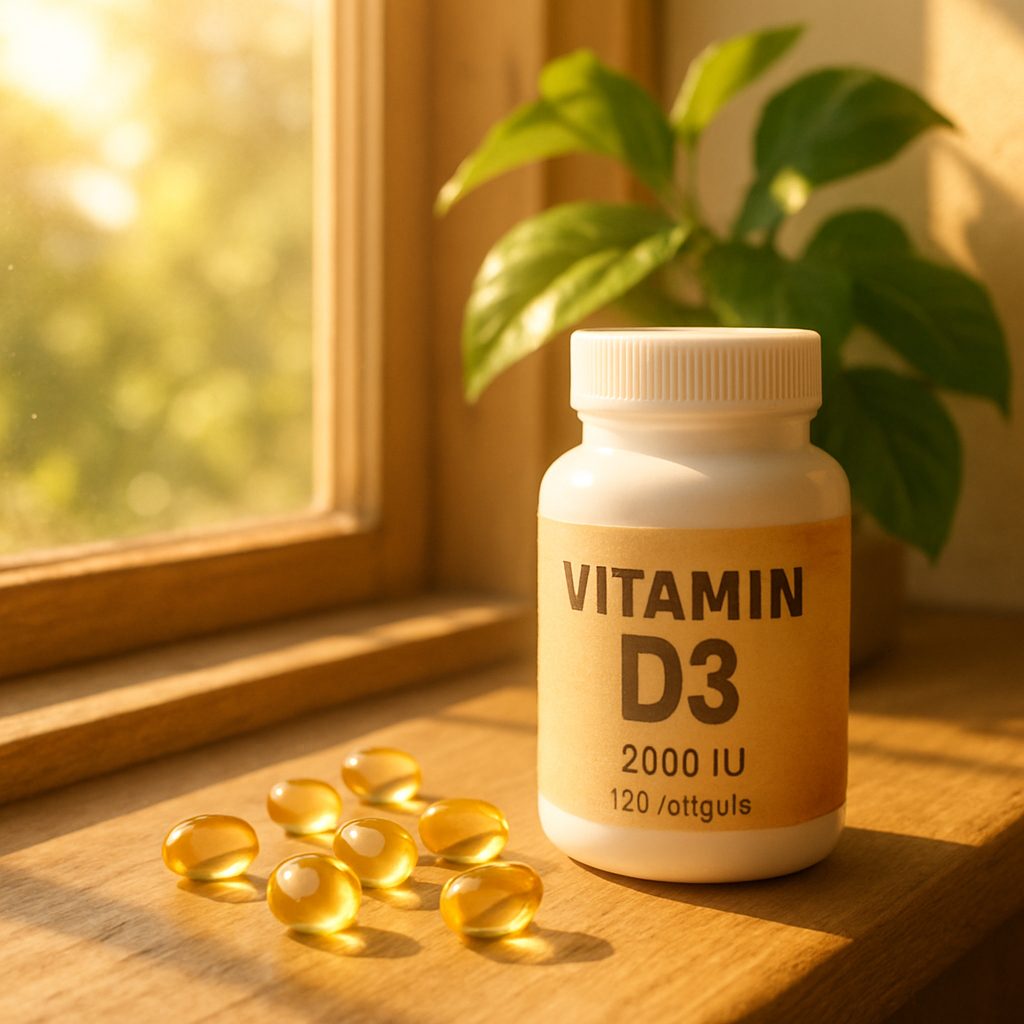
The Overlooked Connection Between Vitamin D and Mental Health
When people think about vitamin D, they typically think bones and immunity. But vitamin D receptors are found throughout the brain, including in areas directly involved in mood regulation: the hippocampus, prefrontal cortex, and hypothalamus. The fact that these brain regions are rich in vitamin D receptors is not coincidental.
Roughly 42% of Americans are vitamin D deficient, and the overlap with depression rates is not lost on researchers. Low vitamin D status has repeatedly shown up as a risk factor for mood disorders, and the mechanisms are becoming clearer.
What Research Links Vitamin D to Depression
The observational data is strong. A large meta-analysis published in the British Journal of Psychiatry (2013) analyzed data from 31,424 participants across 14 studies and found a significant association between low vitamin D levels and depression. People with the lowest vitamin D levels had about a 31% higher odds of depression compared to those with adequate levels.
A landmark population study published in JAMA Network Open (2020) went further. Among 18,353 adults followed over several years, those with vitamin D deficiency had significantly higher rates of depression, and this association held even after controlling for physical health, demographics, and lifestyle factors.
Does Supplementation Actually Help?
The intervention data is mixed but trending positive. A 2020 meta-analysis in Critical Reviews in Food Science and Nutrition reviewed 25 randomized controlled trials and found that vitamin D supplementation significantly reduced depression scores compared to placebo. The effect was most pronounced in people who were actually deficient to begin with, which makes mechanistic sense.
A high-quality trial (VITAL-DEP, 2020) involving over 18,000 adults found that vitamin D3 supplementation (2,000 IU/day) did not significantly reduce depression in a general healthy population. But this was a population without documented deficiency. The key lesson: vitamin D’s mood benefits appear most relevant for people who are actually low, not for topping off an already-adequate level.
How Vitamin D Affects Brain Chemistry
Several mechanisms explain why vitamin D status would affect mood:
Serotonin synthesis: Vitamin D regulates the gene that controls serotonin production. Low vitamin D means less serotonin, the neurotransmitter most closely associated with mood stability.
Neuroinflammation: Vitamin D has potent anti-inflammatory effects in the brain. Neuroinflammation is increasingly recognized as a driver of depression, and vitamin D helps keep it in check. Turmeric is a common addition to a supplement stack for inflammation support; this guide to turmeric supplements for joint pain explains what to look for.
Neurotrophins: Vitamin D appears to support BDNF (brain-derived neurotrophic factor) production, which promotes neuron survival and plasticity. Low BDNF is a well-established feature of depression.
HPA axis regulation: Vitamin D helps regulate the hypothalamic-pituitary-adrenal axis, which governs cortisol release. Dysregulation here contributes to chronic stress and depression.
Seasonal Affective Disorder and Vitamin D
Seasonal affective disorder (SAD), the depression that hits during winter months, has a well-established connection to reduced sunlight exposure. While the primary mechanism involves disrupted circadian rhythms, the corresponding drop in vitamin D synthesis during winter likely contributes. Countries at higher latitudes have both higher rates of SAD and higher rates of vitamin D deficiency, which is not coincidental.
If your mood consistently dips from October through February, getting your vitamin D level tested is a sensible starting point.
What Vitamin D Level Should You Target?
Blood serum 25(OH)D levels are how vitamin D status is measured. Most researchers consider optimal to be 40-60 ng/mL, with the commonly cited “sufficient” threshold of 20 ng/mL being considered too conservative by many clinicians for mood and cognitive health. Getting tested before supplementing is ideal, as it tells you how much you actually need to reach an optimal range.
A general supplementation dose of 2,000-5,000 IU of D3 daily is commonly recommended for adults who are deficient, though higher doses may be appropriate under medical supervision depending on baseline levels.
Why D3 Works Better Than D2 for This
Vitamin D3 (cholecalciferol) raises and maintains blood levels roughly 87% more effectively than D2 (ergocalciferol) based on head-to-head studies. For brain health specifically, the conversion of D3 through the liver and kidneys to the active hormone form (calcitriol) is more efficient than the D2 pathway. D3 is the form your skin makes from sunlight, and it is the form you want in your supplement.
A Supplement That Actually Delivers
Vitamin D3 works best when paired with K2, which directs calcium to bones and away from arteries, allowing you to take higher D3 doses safely. Me First Living’s Vitamin D3 K2 with BioPerine combines D3 with MK-7 (the most bioactive form of K2) and BioPerine for absorption. It is the kind of formulation that addresses the whole picture rather than just dropping D3 in a capsule by itself.
Getting Tested Before You Supplement
The most important step anyone concerned about mood and vitamin D can take is getting a 25(OH)D blood test. It is inexpensive, widely available, and gives you an actual baseline to work from rather than guessing. Many people who feel chronically low-energy or mildly depressed discover they are significantly deficient, and correcting that deficiency often produces noticeable mood improvements within 4-8 weeks.