
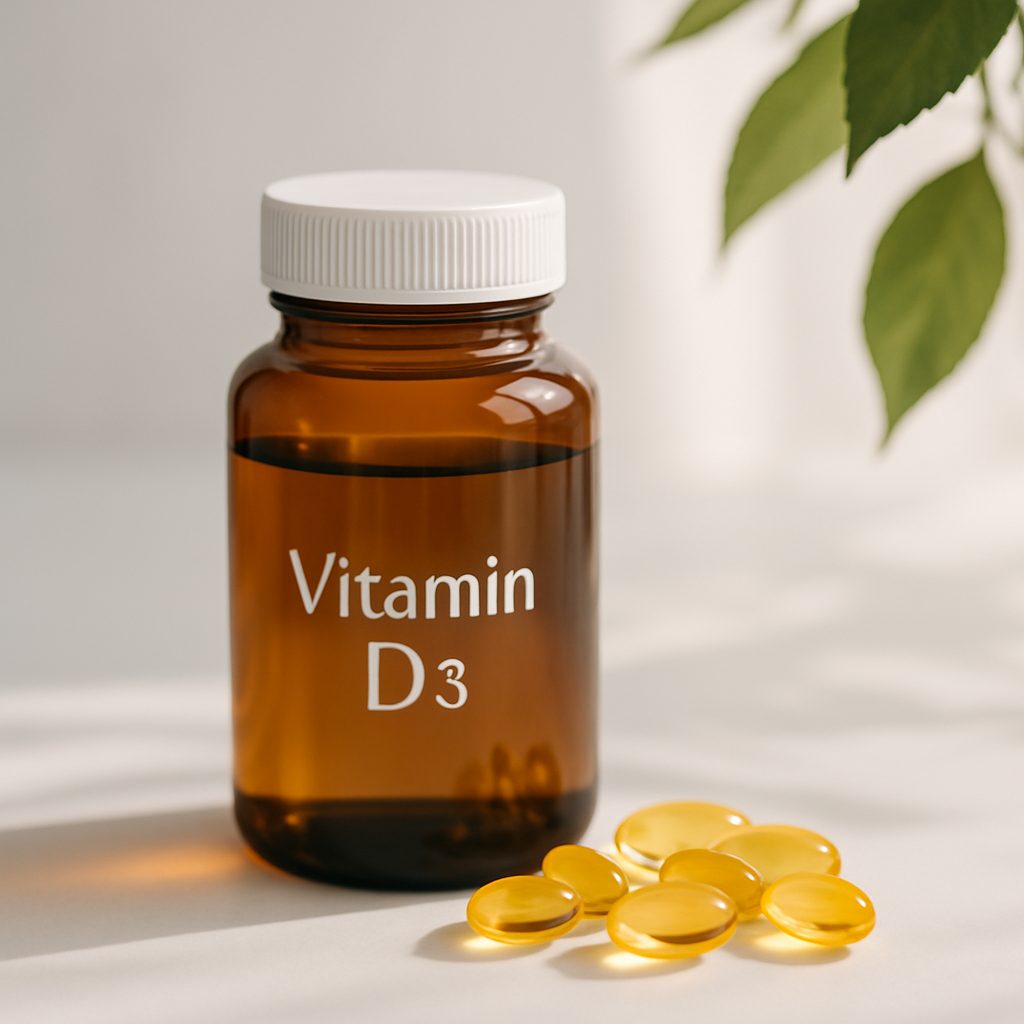
The vitamin D dosage question has two answers: the official government answer and the research-supported practical answer. They differ substantially, and understanding why matters for getting real benefit from supplementation.
The Official RDA and Why It Falls Short
The current Recommended Dietary Allowance (RDA) for vitamin D is 600 IU per day for adults under 70 and 800 IU for adults 70 and older. These values were set to prevent rickets and maintain minimal bone health, not to optimize vitamin D-dependent functions across the body.
The research problem with these figures: multiple studies show that 600 to 800 IU per day is insufficient to raise blood levels of 25(OH)D to the range most researchers consider optimal (40 to 60 ng/mL). A 2014 paper in Nutrients showed that approximately 2,300 to 2,600 IU per day is required for 97.5% of adults to maintain blood levels above 20 ng/mL (the minimum sufficiency threshold). Achieving the higher optimal range requires more.
What the Endocrine Society Recommends
The Endocrine Society, one of the leading professional bodies for hormone and metabolic research, takes a different position from the FDA’s conservative RDA. Their 2011 clinical practice guideline on vitamin D deficiency recommended:
- Adults aged 19 to 50: 1,500 to 2,000 IU per day to maintain blood levels consistently above 30 ng/mL
- Adults over 50: 1,500 to 2,000 IU per day minimum
- Obese adults: 2 to 3 times the standard dose due to sequestration in fat tissue
- Upper safe limit: 10,000 IU per day for adults
Most vitamin D researchers and functional medicine practitioners target 2,000 to 5,000 IU per day as the practical daily dose for adults who are not measuring their blood levels. This range is well below the toxicity threshold and is likely to maintain blood levels in the optimal range for most people.
The Toxicity Threshold
Vitamin D toxicity (hypervitaminosis D) is real but difficult to achieve through supplementation alone. The primary concern is hypercalcemia (elevated blood calcium) and its consequences: nausea, weakness, frequent urination, and kidney stones in severe cases.
The tolerable upper intake level (UL) set by the Institute of Medicine is 4,000 IU per day. But the Endocrine Society and most current research places the safe upper limit for adults at 10,000 IU per day without regular monitoring. Toxicity from dietary and supplemental vitamin D has been documented primarily at sustained doses above 30,000 to 40,000 IU per day.
The risk at 2,000 to 5,000 IU per day is negligible for adults without hypercalcemia disorders or granulomatous diseases (like sarcoidosis) that increase vitamin D sensitivity.
Testing 25(OH)D: Why It Matters
The most reliable way to dose vitamin D is to test your blood 25(OH)D level, supplement to raise it to your target range, and retest every 3 to 6 months. This eliminates guesswork about individual variation in absorption and metabolism.
Target ranges:
- Minimum sufficiency: 20 ng/mL (prevents deficiency symptoms and rickets)
- Adequate: 30 to 40 ng/mL (most standard clinical guidelines)
- Optimal (research-supported): 40 to 60 ng/mL (most vitamin D researchers)
- Caution: Above 80 to 100 ng/mL (begin to approach excess territory)
Testing is straightforward. A standard blood panel including 25(OH)D is available through most labs for $30 to $60 without a doctor’s order through direct-to-consumer testing services.
The Sun Exposure Reality
Many people hope to get enough vitamin D from sun exposure rather than supplementation. The reality is complicated by several factors:
- At latitudes above 35 degrees north (roughly the latitude of Los Angeles), UVB rays are insufficient for vitamin D synthesis during winter months (approximately October through March)
- SPF 15 sunscreen reduces vitamin D synthesis by approximately 99%
- Glass blocks UVB rays, so sitting in a sunny window produces no vitamin D
- Melanin reduces UVB absorption; people with darker skin need 3 to 6 times longer sun exposure for equivalent D3 synthesis
- After age 70, skin produces vitamin D at roughly 25% the efficiency of young adults
For most adults in the continental US, supplementation is necessary to maintain adequate vitamin D levels year-round, particularly during fall and winter.
Practical Dosing Summary
| Goal | Suggested Daily Dose |
|---|---|
| Maintain minimum sufficiency (with no testing) | 1,000 to 2,000 IU |
| Target optimal range (no testing) | 2,000 to 5,000 IU |
| Correct confirmed deficiency (under medical supervision) | 5,000 to 10,000 IU short-term |
| Absolute safe upper limit (healthy adults) | 10,000 IU |
Timing and Absorption
Vitamin D is fat-soluble. It absorbs best when taken with a meal containing fat. A 2010 study in the Journal of Bone and Mineral Research found that taking vitamin D with a fat-containing meal increased absorption by approximately 50% compared to taking it fasted.
Morning with breakfast or lunch with any fat (olive oil, nuts, avocado, even a small amount of butter) is the ideal timing for most people. The specific meal does not matter much; what matters is that there is fat present.
For more on what to look for in a D3 supplement including K2 pairing and BioPerine for absorption, see our guide to the best vitamin D3 supplements. For the specific rationale on K2 pairing, see why you need K2 with D3.